 By Sytech
 18 Sep, 2026
 11 Minutes Read
Cracking on curved flexible stone panel installations almost always comes from exceeding the panel’s minimum bend radius, bonding over an out-of-tolerance substrate, or using an adhesive that can’t accommodate the differential stress at concave/convex transitions. Install within the manufacturer’s rated radius, prep the substrate to a flatness tolerance suited to curved work, stagger joints away from the tightest curvature, and use an adhesive system matched to the substrate, and cracking is preventable, not just something you hope doesn’t happen. Most online guides treat curved-wall installation as a craft project. It’s an engineering problem, and it deserves engineering answers.
Key takeaways
Walk into any forum discussion of flexible stone veneer and you’ll read the same line: thin natural stone bonded to a flexible backing. That description is wrong for products like ANGTAI’s flexible stone-look panels, and the difference isn’t semantic. It determines how the panel behaves when you bend it around a column.
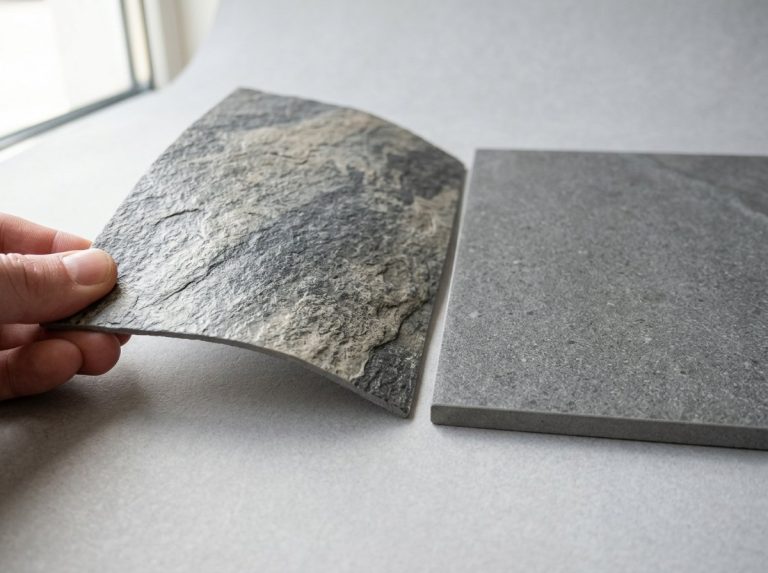
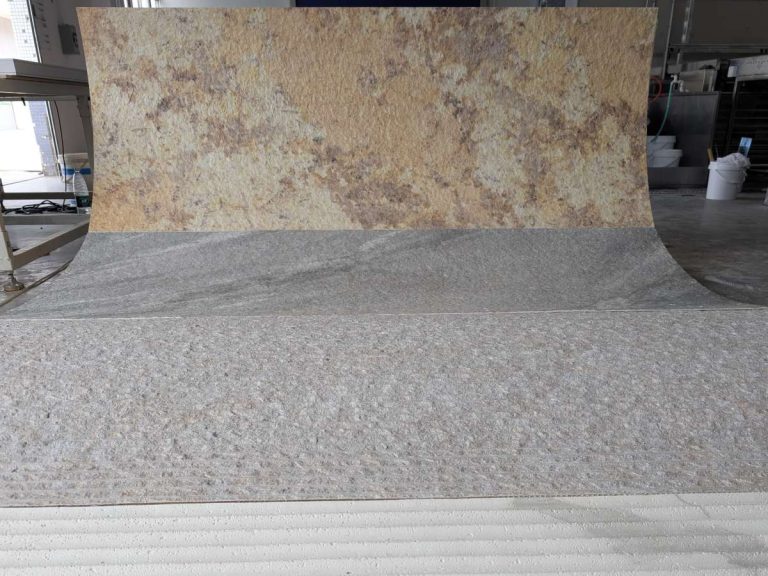
ANGTAI’s flexible stone-look panels use a flexible MCM (Modified Clay Material) or soft porcelain substrate finished with water-based, inorganic, non-fired inkjet surface decoration. There’s no quarried stone slice involved. The visual finish is printed onto a manufactured composite base, not cut from rock.
Fire classification, bend behavior, and cracking risk are properties of the substrate, not of “stone.” As a general comparison, genuine mineral materials and manufactured MCM composites tend to respond to bending stress through different mechanisms, with the MCM composite engineered specifically to accommodate flex. Treating them as interchangeable in a spec sheet is how curved-wall projects end up with cracked panels and a confused warranty claim.
Don’t assume generic “flexible stone” marketing claims apply across every brand. Request product-specific documentation for the exact model you’re specifying, and if you’re still comparing material categories, read our breakdown of flexible stone wall panel pros and cons before locking a product line for a curved application.
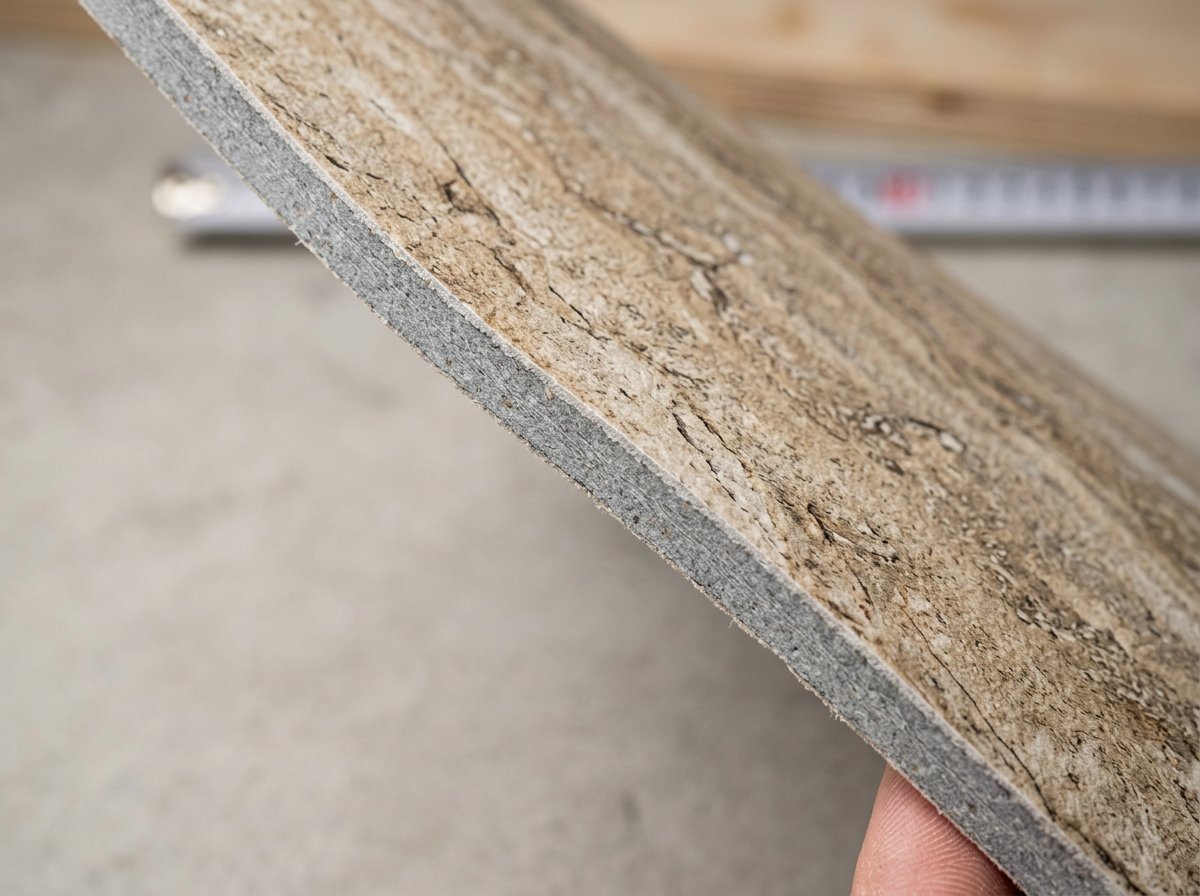
Exceeding a panel’s minimum bend radius is the single most common cause of cracking on concave and convex walls, columns, and archways. It’s also the number competitor installation guides almost never mention, probably because it varies by product and forces a harder conversation before the sale.
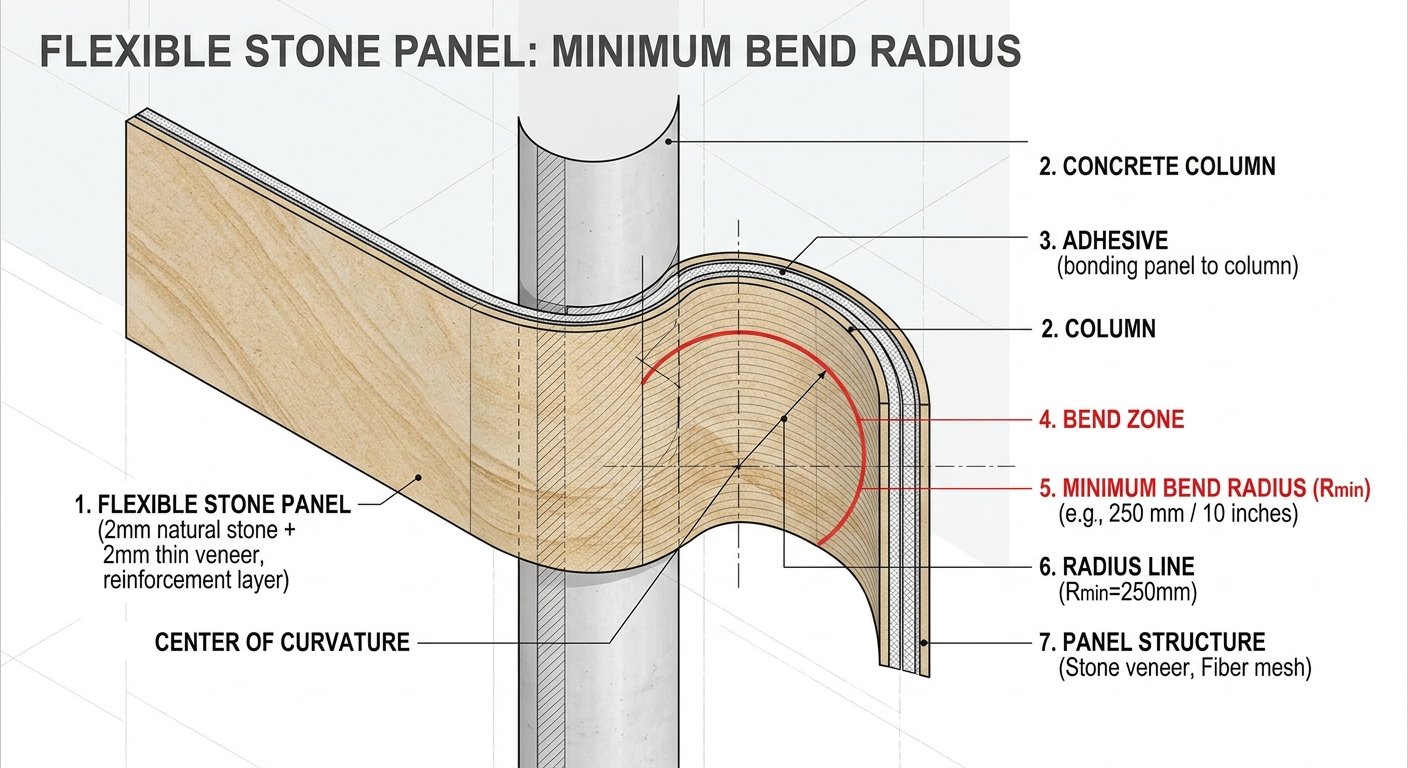
Bend radius is model-specific. It depends on panel thickness, substrate composition, and backing flexibility, so it has to be confirmed against current product specifications rather than assumed from a generic “flexible stone” claim. A panel rated for a gentle archway sweep is not automatically rated for a tight column return.
Standard panel sizes across product lines range from 600×1200 mm up to 1200×3000 mm. A large-format 1200×2400mm panel behaves very differently on a tight column radius than a 600×1200mm panel does on the same curve; more surface area means more material fighting the bend at once, concentrating stress at the panel’s weakest point.
Measure the tightest radius on the actual project. Request the rated bend radius for the candidate panel model. Then confirm with a physical sample bent on a mockup built to that exact radius, not a generic curve. Sample dispatch is generally available within approximately five business days after price confirmation, subject to availability, which is cheap insurance against a full production run that won’t conform.
A substrate irregularity that would be invisible on a flat wall becomes a stress concentration point on a curve. High spots push the panel outward beyond its intended arc; voids leave the panel unsupported and flexing under its own weight. Either way, that’s where cracks start.
Panels in ANGTAI’s line are designed for direct adhesive installation over several substrate types: concrete, cement board, OSB, aluminum-plastic panel, calcium-silicon board, and plate metal. Each has different prep requirements, but on a curve the shared priority is consistent curvature, not absolute flatness in the traditional sense.
If you’re building a curved substrate frame from scratch, ribs or studs should follow the design radius precisely and at tight enough spacing to prevent facets between supports. If you’re skinning an existing curved masonry wall, check the wall’s actual radius against the design drawing. Masonry walls built decades ago rarely hold a perfect curve, and that gap between drawing and reality is where field problems surface.
Before bonding, allow panels and substrate to acclimate to project site conditions. Bonding a cold panel to a substrate at a very different temperature invites dimensional mismatch right at the bond line, exactly when you’ve already added curvature stress on top of it. Confirm the recommended acclimation and bonding conditions for your specific product model with ANGTAI before installation.
Getting the adhesive step right on a curve is less about which brand of adhesive you grab and more about matching chemistry to substrate and applying it in full coverage. Spot bonding, the shortcut everyone’s tempted to take, is a leading cause of hollow spots and cracking under point load specifically on curved runs.
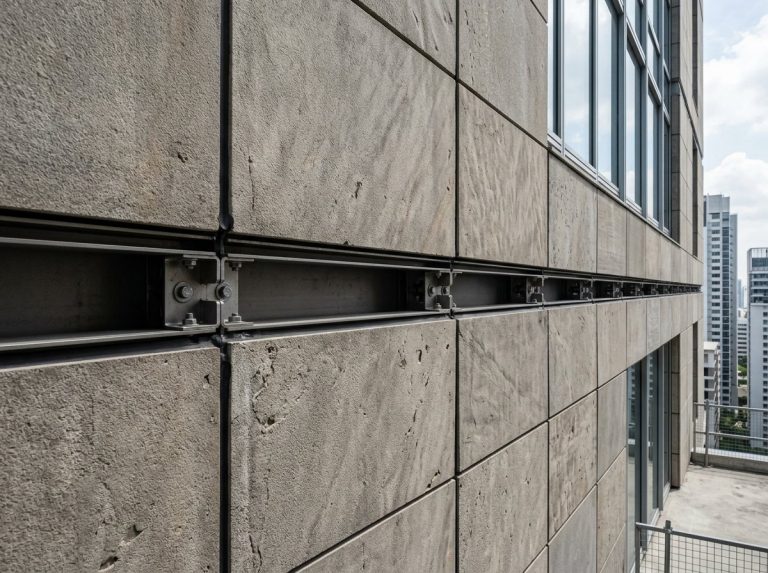
These steps matter more on exterior applications, where panels also face weather cycling. For facade-specific context, see our guide on rainscreen cladding systems and flexible stone panels.
Put these four options side by side on an actual curved wall project, and the differences stop being theoretical. Flexible MCM/soft porcelain panels can conform directly to a curve within their rated bend radius. Natural thin stone veneer generally cannot bend at all; it requires segmented or mitered installation to fake a curved appearance, piece by piece. Precast concrete curved panels require a custom mold built for that specific radius, adding lead time before production even starts. Ceramic tile needs small-format pieces to approximate a curve, which multiplies joint count and labor.
For procurement, that difference shows up as lead time and cost exposure. A custom concrete mold is a project-specific capital cost. Segmented stone veneer adds skilled mitering labor. Small-format tile adds installation hours. A panel engineered to flex within a known radius skips most of that.
Exact weight, thickness, and cost figures are model- and project-specific, and should be confirmed with the supplier rather than taken from a generic comparison table, including this one. Use it to frame the conversation with your sourcing team, not as a final spec. For cost context specific to this category, see our breakdown of exterior stone panel cost factors.
Quality control on the manufacturing side matters here too. ANGTAI runs more than 30 process-testing checkpoints during production before a panel ships, which reduces the odds that a dimensional or material defect shows up only after it’s bonded to your curved wall.
Browse the full product range or review rainscreen cladding manufacturer options before finalizing your spec sheet.
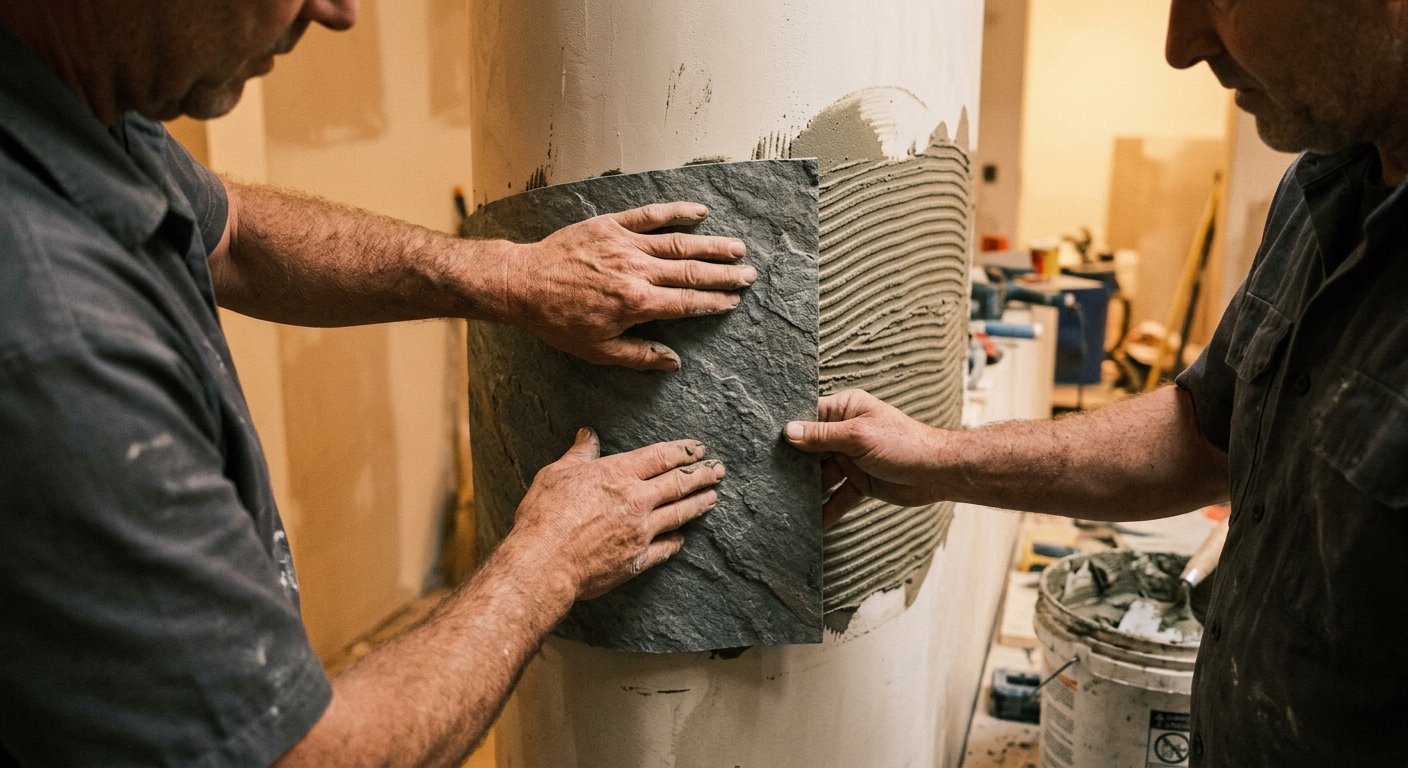
Three variables are entirely within your control on a curved wall project: staying within the panel’s rated bend radius, prepping the substrate to a tolerance appropriate for curved work, and getting the adhesive and joint detailing right for that substrate. Get those three right and cracking stops being a risk you manage and starts being a non-issue.
Before you finalize an order, request model-specific bend radius data and insist on a sample mockup bent to your project’s actual tightest curve. Don’t let generic “flexible stone” marketing language substitute for a real spec sheet.
ANGTAI is a factory-direct supplier of lightweight flexible stone and soft porcelain wall cladding for interior and exterior projects, with OEM/ODM production available for private-label and custom-pattern orders. Contact ANGTAI for product-specific specifications, a sample dispatch, and a quotation matched to your curve radius and substrate.
It depends on the panel model’s rated minimum bend radius relative to your column’s actual curve. Smaller-format panels generally conform more easily to tight radii than large-format panels. Always confirm the rated bend radius for your specific product and test with a sample mockup before ordering a full run.
No, not in ANGTAI’s product line. These panels use a flexible MCM (Modified Clay Material) or soft porcelain substrate with water-based, inorganic, non-fired inkjet surface decoration, not a thin slice of quarried stone. That distinction affects bend behavior, fire classification, and how the product should be specified.
Adhesive selection depends on the substrate: masonry, cement board, OSB, or metal each require a compatible bonding chemistry. Apply adhesive across the full panel back rather than spot bonding, and confirm the recommended system with the panel manufacturer for your specific substrate and project conditions.
13 Oct, 2026
10 Oct, 2026
08 Oct, 2026
18 Sep, 2026
 Guidelines
 Guidelines
 Guidelines
 Guidelines
 Guidelines
 Guidelines